Captain Bob Desh, U.S. Coast Guard, Retired
Regent, Foundation for Coast Guard History
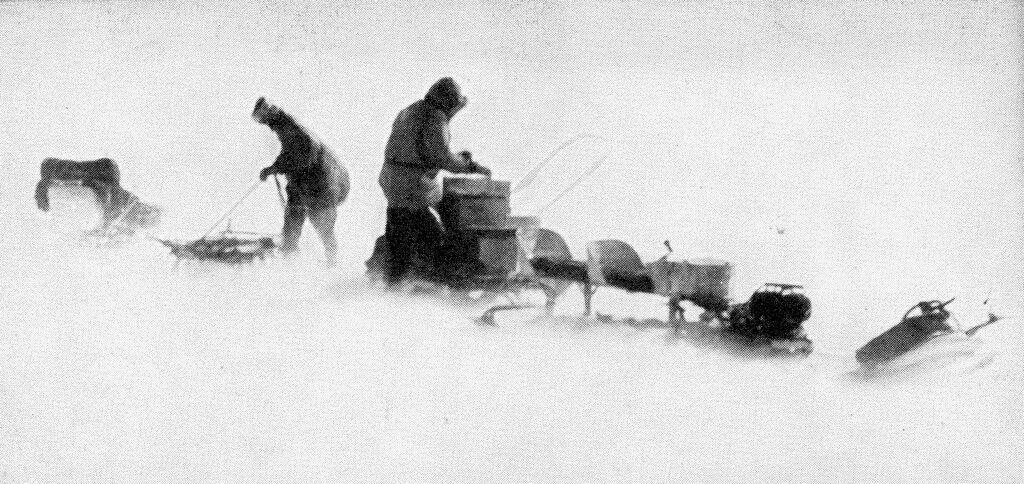
With the signing of a protection agreement between Greenland and the United States in 1941, the U.S. Armed Forces became responsible for the defense of the world’s largest island. Of the many challenges of the mission, preventing the enemy from establishing weather stations along Greenland’s vast, rugged, unpopulated northeast coast was top of mind. In addition to ice capable Coast Guard cutters patrolling from the sea, a small group of Danish, Norwegian, and Greenlandic Inuit hunters were organized to patrol this expansive stretch of inhospitable coastline by dogsled in search of German interlopers. The North-East Greenland Sledge Patrol was one of the most unique military units of the war and is a lasting legacy of the Coast Guard’s defense of Greenland.
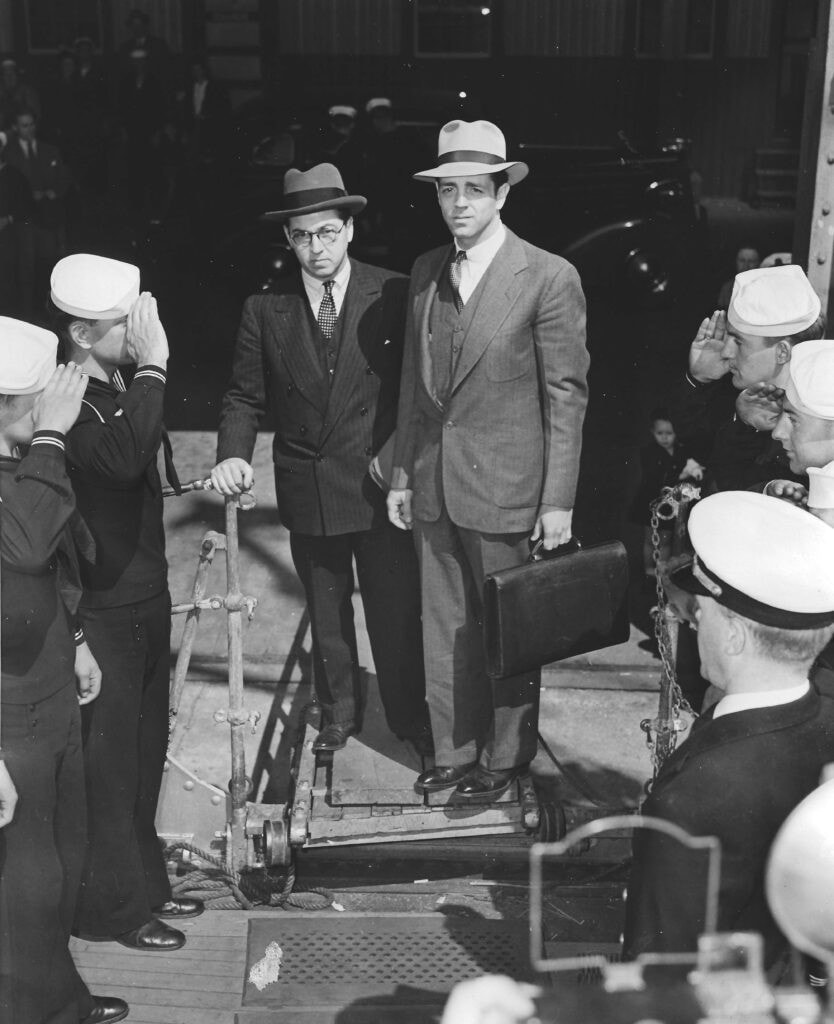
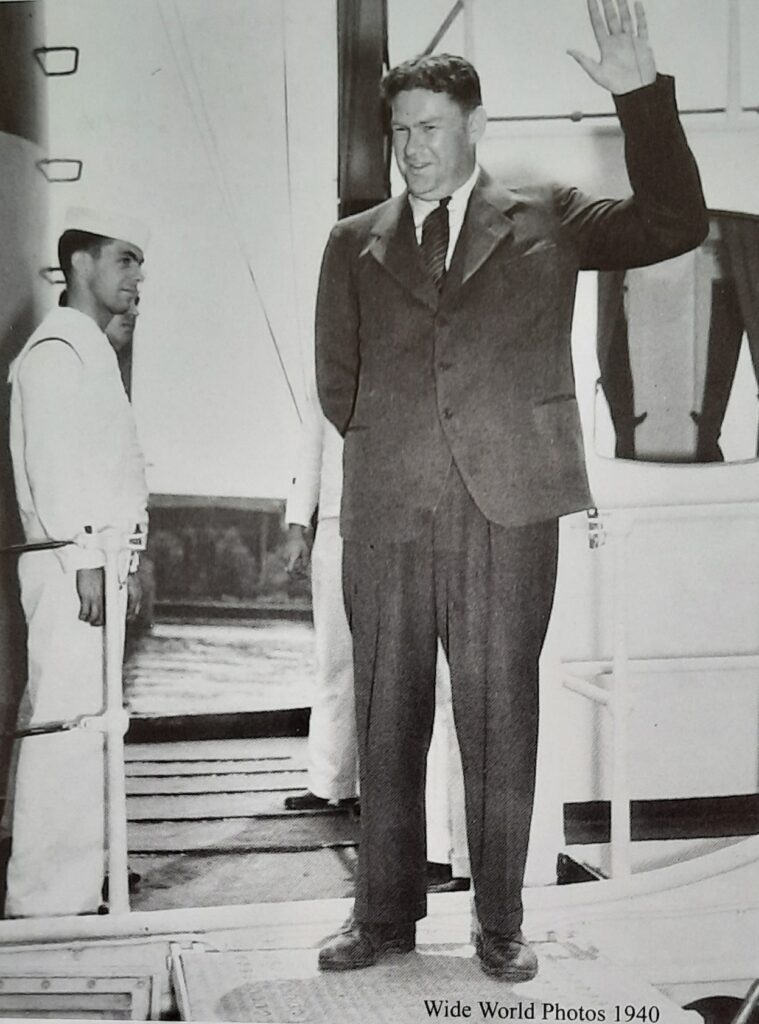
When Germany invaded Denmark in April 1940, Copenhagen’s response was to form a government that collaborated with the Germans. While most domestic processes remained intact, Denmark’s foreign policy became far more complicated. This included governance of its colony, Greenland. Germany gaining control of Greenland by way of occupying Denmark was wholly unacceptable to the United States. To provide an official diplomatic presence, plans were made to establish a U.S. consulate in Greenland. On 20 May 1940, the U.S. Coast Guard Cutter Comanche delivered United States consul James Penfield and vice consul George West Jr. to the capital city of Godthab on Greenland’s west coast.
Prior to Denmark falling to Germany, the massive, largely uninhabited island was governed by the Greenland Administration in Copenhagen, with two local governors running the colony’s day-to-day affairs. Eske Brun was the governor of North Greenland and Aksel Svane of South Greenland. Danish ambassador to the U.S., Henrik Kauffmann, was the other key player. The Greenland Constitution of 1925 required that the island be governed in the best interest of the Greenlanders. All three were focused on an alliance with the U.S.; however, each had personal thoughts and agendas. After a brief power struggle, Kauffman and Brun came out the winners. Brun returned to the island as the governor of all Greenland. Kauffman became the island’s spokesman and authority in Washington, with Svane as his subordinate.
Birth of the North-East Greenland Sledge Patrol
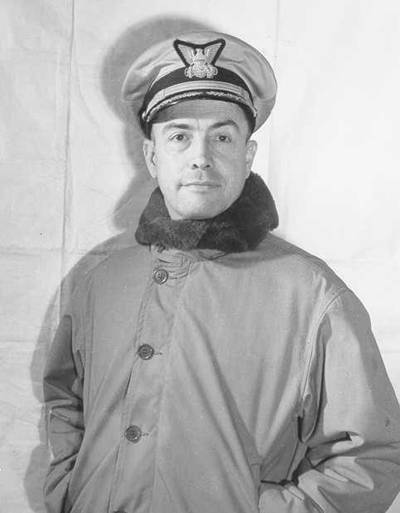
Every now and then in history, leaders with the ideal skills and experience are in the right place at the right time. For the North-East Greenland Sledge Patrol those men were Governor Eske Brun and U.S. Coast Guard Commander Edward “Iceberg” Smith. Smith’s motivation was simple and straightforward. He understood that because of the extraordinarily harsh weather and ice conditions along the northeast coast, coupled with long winters of nearly continual darkness, neither his vessels, nor the Army’s aircraft, would be capable of ensuring that the Germans would not be successful in establishing crucial weather and communication stations. For Eske Brun, this was the opportunity for Greenland to play a meaningful role in its own defense. While both Smith and Brun played crucial roles in the standup of the Sledge Patrol, history will continue to rightfully recognized Smith as the man most responsible.
The first step in the process was an order from Smith to have all inhabitants come south to Scoresby Sound. With the coast completely cleared, anyone found there could be treated immediately as an enemy. As it turned out, there were only 27 people, 26 men and one woman, along 700 miles of coast. Most moved to designated locations for transport south by the Coast Guard; others made the trek on their own. All personnel, some unwillingly, drifted south to the Scoresby Sound as ordered by summer’s end, 1941.
A request went out to those gathered at Scoresby Sound for volunteers interested in joining the Sledge Patrol. There was no shortage of eager candidates. Even those who didn’t really appreciate or understand the potential threat were happy with the opportunity to go on doing what they had done before the war interfered and be relatively well paid for it. Fifteen were chosen as the “plank owners” of the North-East Greenland Sledge Patrol. Over the course of the war, the complement of the Patrol stayed relatively constant, with personnel flowing in and out of the unit. A total of 27 men would serve with the North-East Greenland Sledge Patrol between 1941 and 1945.
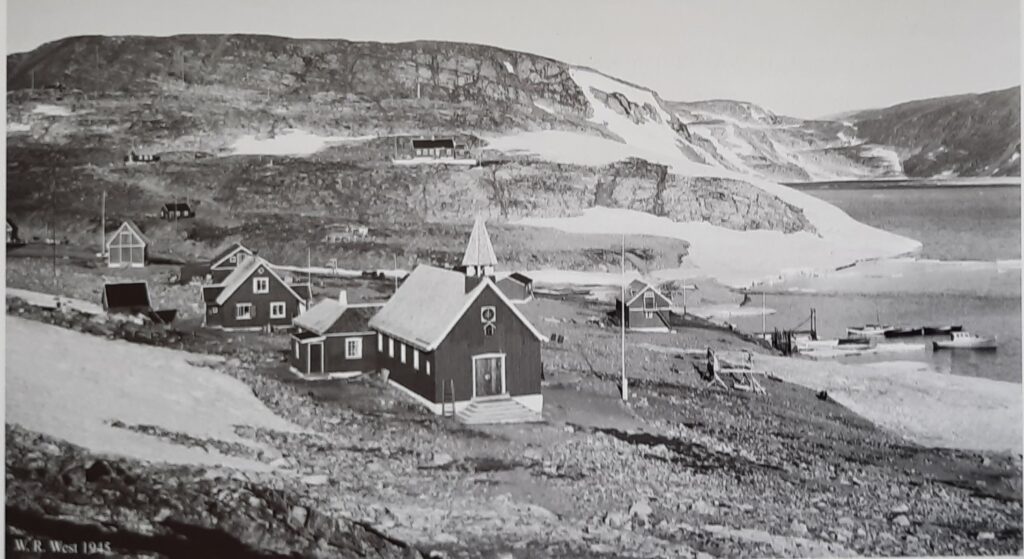
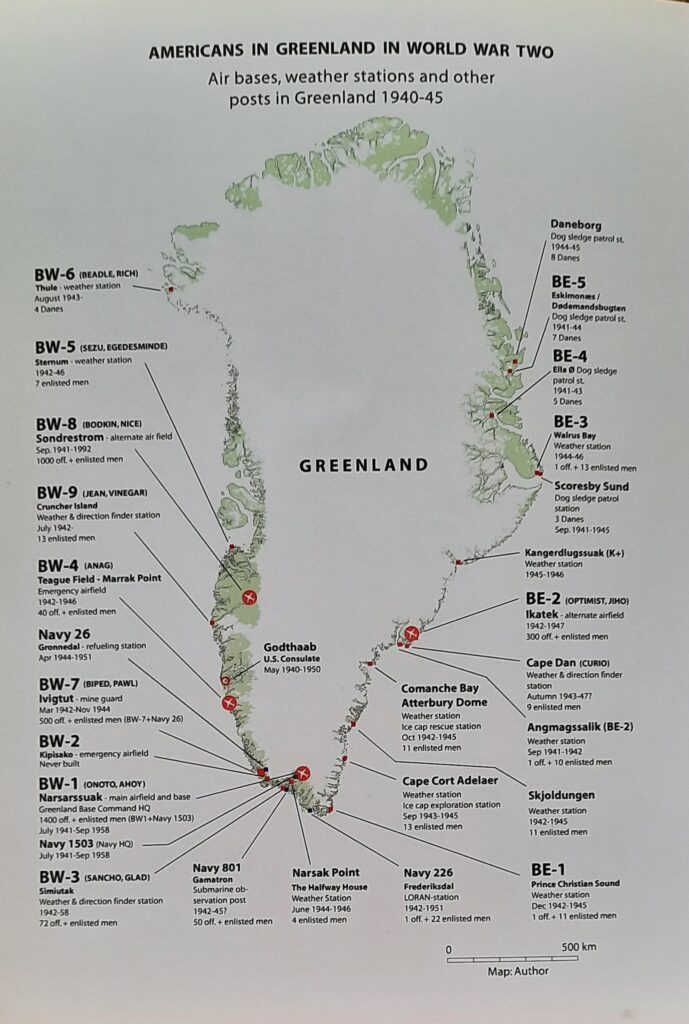
Ib Poulsen was selected to be the overall commander of the Sledge Patrol. The son of a bookseller in a provincial Danish town, a temporary summer job brought him to Greenland. Northeast Greenland would become his passion. He spent several years as a hunter and radio operator at one of the Danish weather stations. Poulsen divided his personnel into three groups. One team would operate from Scoresby Sound (Bluie East 3), the bulk of the crew would be divided into two larger teams stationed at former research stations located at Ella Island (Bluie East 4) and Eskimoness (Bluie East 5).
It is hard to imagine that anyone ever had a more expansive and isolated command than that of Ib Poulsen. His civilian boss, Governor Brun, was on the other side of the massive Greenland icecap. The Coast Guard cutter Northland, and the other ships and personnel of the Greenland Patrol, were his support network and most important military allies. However, come winter, they too would depart to avoid being trapped by the rapidly forming coastal icefield.
With personnel, essential supplies, and an initial plan in place, the Sledge Patrol began operations in September 1941. Its mission was threefold – coastal reconnaissance, meteorological observation and reporting, and maintaining a visible presence of Greenland sovereignty in the region. Poulsen chose the station at Eskimoness as his command center, a critical location for gathering the weather observations. The patrol showed its worth almost immediately after beginning operations, reporting that a suspicious-looking party of men had landed near the entrance to Franz Joseph Fjord. Cutter Northland investigated, locating and capturing the Norwegian fishing trawler Buskoe attempting to establish a weather station in MacKenzie Bay.
Four-legged Elite Sensor Packages
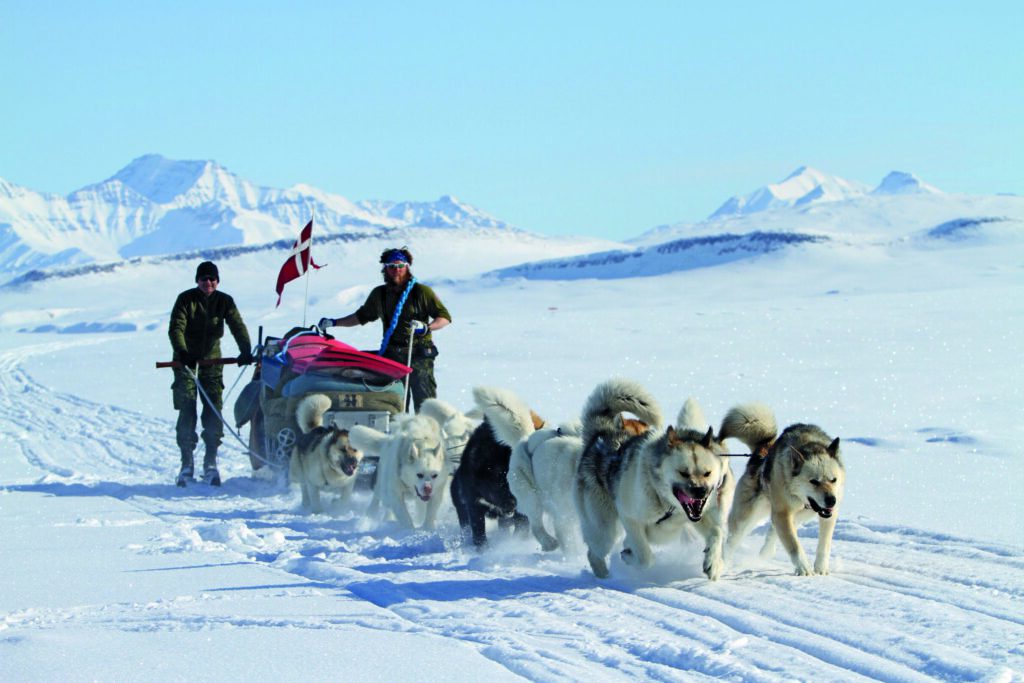
Sledge dogs are ideally suited for their environment. They did much more than just drag the driver’s gear across the ice and snow; the dogs were companions and protectors. Sledge dogs are intelligent and inquisitive, and their keen sense of smell is almost incomprehensible to humans. Downwind, they can scent a man, a bear, or a hut that is lived in, two or three miles away. More importantly for reconnaissance, they will always go towards the scent unless the sledge driver stops them.
Weather Station Holzauge
In the summer of 1942, the German trawler Sachsen sailed from Kiel on a secret mission to Greenland with orders to establish a covert weather and communication station. The ship was under the command of Lieutenant Hermann Ritter, a seasoned Arctic merchant mariner, now serving in the German Navy. He had hoped to land at Shannon Island, but the sea ice forced him to choose a tiny fjord called Hansa Bay on Sabine Island. The weather station ashore was code named Holzauge.
On 8 March 1943, as sledge patrolmen Marius Jensen, Mikael Kunak and William Arke approached Sabine Island, their dogs alerted—ears up, tails out—and began to move more quickly. As they cleared a rise, they saw a wisp of smoke rising from the chimney of a hunting station. Two men ran away up the hills behind the hut. Approaching cautiously, they found the stove still burning, two half-empty mugs of coffee on the table, sleeping bags, Nazi uniforms, and other supplies. The three immediately set off for Bluie East 5 to inform Poulsen.
The two German hunters made their way quickly back to Holzauge. Two search parties were organized with orders to find the sledge drivers and bring them back; alive, if possible, dead if necessary.
The Greenland Army
Poulsen reported the German outpost on Sabine Island by radio, requesting guidance. Governor Brun’s encrypted message response to Poulsen on 14 March 1943, clearly articulated the Sledge Patrol’s tasking – “eliminate the enemy.”
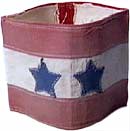
Having operated essentially as a paramilitary police force since the fall of 1941, the North-East Greenland Sledge Patrol was now facing combat operations. Brun’s solution was creative and unorthodox. As far as he knew there was no prohibition for a colonial governor creating an army, so he did: the Greenland Army. He wrote out a set of commissions and appointments and sent the signal to Poulsen. The Sledge Patrol was now a military unit. Identifying arm bands were crafted to indicate their military status, with the number of stars indicating officer rank and vertical bars enlisted grade—problem solved. The Sledge Patrol’s military status was later reinforced by co-designating them an auxiliary unit of the U.S. Army Reserve. Seeing the humorous side of what he had done, Brun began calling himself “General.”
Contact with the Enemy
Not being one to sit on his hands, Poulsen began consolidating his forces at Blue East 5. Also concerned that Peter Nielsen, on patrol to the far north, would stumble into the Germans, Poulsen dispatched Marius Jensen and Eli Knudsen to look for him. That left Poulsen, Kurt Olsen and seasoned arctic hand, Henry Rudi at the station.
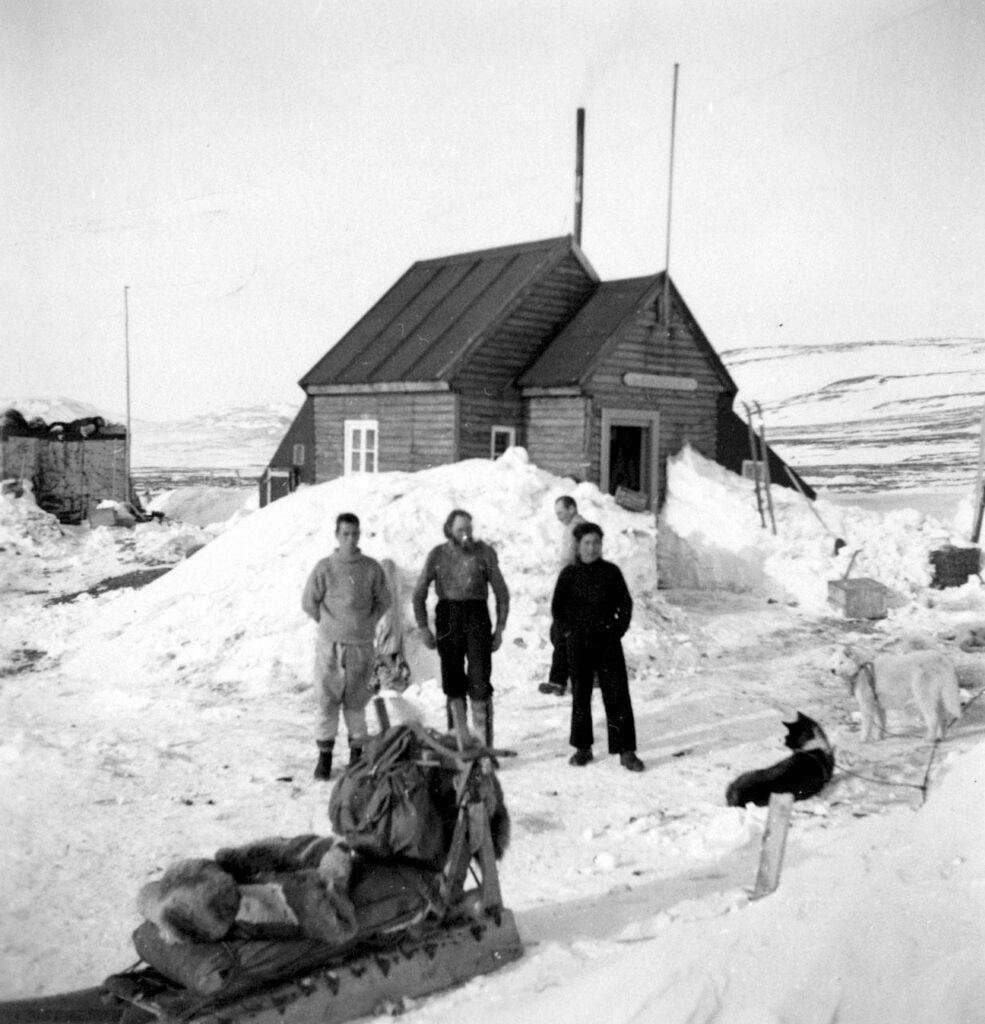
On the evening of 23 March, Poulsen had completed his rounds of the station. Henry Rudi, on watch, shouted, “Poulsen, I think there’s somebody on the ice!” Poulsen grabbed his rifle and headed outside. After brief verbal exchanges, first in Danish, then German, he heard the challenge: “Do you intend to offer armed resistance?” His answer in the affirmative was met instantly with tracer fire from automatic weapons. In a hail of gunfire, he, Olsen, and Rudi scattered and escaped. In less than ten minutes, Bluie East 5 had been lost. Over the course of the next eleven days, all three miraculously survived the 230-mile hike to Bluie East 4 at Ella Island.
Farther to the North, Jensen and Knudsen had located Nielsen and were working their way back to Bluie East 5. Because Marius Jensen was driving a mismatched dog team the party was far more spread out than normal, with Knudsen often far ahead. As he approached his former hunting station at Sandodden, a hungry and tired Knudsen decided not to wait for the others. As he approached, the Germans were lying-in-wait. When Knudsen saw them rise, he made a run for cover behind a rock outcropping. Ritter gave the order to “shoot the dogs!”—intending to stop the sledge and capture Knudsen alive. In a tragic twist of fate, the machine gun jammed after the first burst felled many of the dogs. In clearing the weapon, the gunner’s second burst was off target, accidently killing Knudsen. The next morning Jensen and Nielsen drove down the pass following Knudsen’s tracks to the cabin. The Germans once again rose from their hiding spots in the snow and easily apprehended both Jensen and Nielsen without a fight.
His base discovered, Ritter’s main goal was survival until ice conditions would allow the Sachsen and his crew to escape back to sea. He also set into motion plans for potential emergency evacuation by German aircraft. Discussions with his crew and the two captives led to a multifaceted plan. The unit’s head meteorologist and ship’s physician, along with the best of the German sledge drivers would set out for Ella Island to attack Bluie East 4. As odd as it sounds, in response to an emotional appeal from Marius Jensen, Peter Nielsen would be allowed to take a sled team back to Sandodden to fortify Knudsen’s grave to protect his corpse from foxes and other invaders. In exchange, Jensen would lead Ritter on a reconnaissance mission to the north and east.
A severe storm required both the German assault team and Ritter and Jensen to take shelter at a hunting station at Mosquito Bay. When the storm subsided, the Germans requested guidance from Jensen on the best route to Bluie East 4. Seizing the opportunity, he recommended a route that he knew would be challenging in the newly fallen snow. When they had departed, an inattentive Ritter left his rifle unattended, and Jensen was able to take Ritter prisoner.
On 25 May 1943 a flight of U.S. Army Air Force B-24 bombers flew from Iceland and attacked the German base at Hansa Bay. The base buildings were damaged, but the ship survived. Most importantly, the meteorological equipment was destroyed, bringing an end to weather station Holzauge. A month after the air attack, the entire crew of the weather station, except for Dr. Rudolph Sensse, who had gone to look for Ritter, was evacuated by a German long-range sea plane. Prior to their departure, the Germans burned the remaining building and scuttled Sachsen with explosive charges. Cutter Northland made it through the ice to Sabine Island in late July with Sledge Patrol Captain Niels Ove Jensen and a dog sled team aboard. The Coast Guardsmen located and captured Dr. Sensse.
The Sledge Patrol would again face off in armed conflict with the enemy on 22 April 1944 at Cape Sussi on Shannon Island where specially equipped ice capable trawler Coburg had established a weather station. A six-man Sledge Patrol assault team led by Captain Niels Ove Jensen located and attacked the station. During the firefight, the German military commander, Lieutenant Helmuth Zacher, was killed. The skirmish led to the Germans abandoning the station and evacuating the crew by airlift. The Coast Guard reached the abandoned station in August, inventorying the equipment and documenting Lieutenant Zacher’s gravesite.
War Ends, Sledge Patrol Continues
Denmark was liberated on 5 May 1945. The U.S. awarded the Legion of Merit Medal to Sledge Patrolmen Captain Ib Poulsen, Captain Niels Ove Jensen, Lieutenant Marius Jensen, and Corporal Eli Knudsen (posthumously) for their valor in action against the enemy.
The North-East Greenland Sledge Patrol was disestablished at war’s end. More accurately, it was a very short-lived pause. Immediately after the war, some members of the unit stayed on, reverting to their original “police” status.
Escalation of the Cold War led to a need for improved surveillance in the Arctic. The North-East Greenland Sledge Patrol was reorganized in 1950. The name was later changed to Resolute Dog Sled Patrol and eventually to Sirius Dog Sled Patrol. Informally known as Siriuspatruljen (the Sirius Patrol), the present-day patrol is an elite Royal Danish Navy unit that continues to ensure Danish sovereignty in northeast Greenland.
A branch of the Danish Special Forces operating under the Joint Arctic Command, the Sirius Patrol is headquartered at Daneborg. Its mission and operations are essentially identical to its World War II predecessor, including providing critical meteorological data.
Lasting Legacy
The North-East Greenland Sledge Patrol, brainchild of Iceberg Smith and Eske Brun, was a very successful “proof of concept.” The unique unit that they created in Scoresby Sound lives-on today. The Sirius Dog Sled Patrol is an extraordinary legacy of the U.S. Coast Guard’s defense of Greenland during World War II. The dedicated Danish sailors who serve today trace their roots directly to those original 15 volunteers who met with Iceberg Smith and the crew of the cutter Northland in September of 1941.
[A longer essay with more details and images is available in the FCGH’s Autumn 2023 issue of The Cutter, page 6: https://fcgh.org/autumn-2023/]
Note: This article was previously published as part of the United States Coast Guard’s The Long Blue Line Series.