Brian R. McMahon
U.S. Coast Guard Auxiliary
[Editor’s note: Auxiliarist Brian McMahon’s interview with Stanley Berman took place in February 2024 and Mr. Berman passed away later that year.]
Although 103 years old, Mr. Stanley Berman was lucid and eager to talk about his experiences in the Pacific War, though his failing hearing necessitated that I ask questions into a microphone that was directly connected to headphones that he wore.
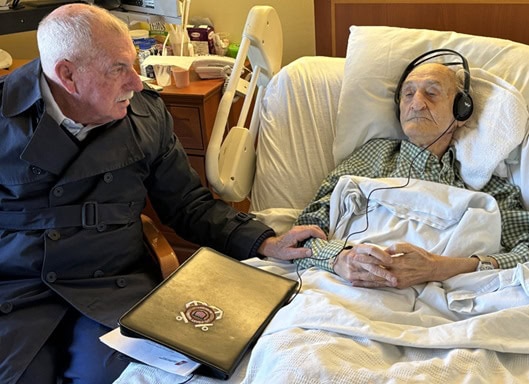
We started the interview by having him relate his situation in 1944, when he was age 24, recently married to Anita, and certain that he would be drafted into the Army. Summoned for the draft board’s physical in Boston, he saw a trail of yellow footprints on the floor and followed them to the U.S. Coast Guard Recruiting Station, where he promptly joined up, rather than be drafted into the Army.
Mr. Berman’s first duty station was Newport, Rhode Island, where he was part of the Coast Guard’s beach patrol, preventing spies and saboteurs from landing ashore in dinghies launched from U-Boats, as had happened at Amagansett on Long Island, New York, and Ponte Vedra, Florida. He also served on a harbor fireboat which was called on to extinguish a blaze on moored freighter. According to Mr. Berman there was no boot camp for new Coast Guardsmen in 1944, it was all on-the-job training.
During World War II, the Coast Guard came under the Navy Department, and many U.S. Navy troop transports, landing craft, and fleet auxiliaries had Coast Guard crews. Mr. Berman’s next duty station was part of the commissioning crew of USS LST (Landing Ship, Tank) 763 that was completed in Ambridge, Pennsylvania, a city near Pittsburgh, in just ten weeks. To join the Pacific War, the LST headed west on the Ohio River, and then south, down the Mississippi River to New Orleans with its complement of 13 officers and 104 crew members. The amphibious assault ship then steered southwest to the Panama Canal and then north to San Diego.
It took some time for Mr. Berman to get accustomed to the close quarters of a ship underway, but he made some friends that endured for decades after the war. Like many Coast Guard and Navy veterans, they scheduled annual reunions around the country to swap reminiscences while their wives would catch up on how their children were doing. He was disgusted with LST 763’s captain who was an incompetent alcoholic, who never attended a reunion and was universally disparaged for not giving a farewell address to the crew when LST 763 returned home from the war. In contrast, Mr. Berman respected the ship’s Executive Officer, who was demanding but fair.
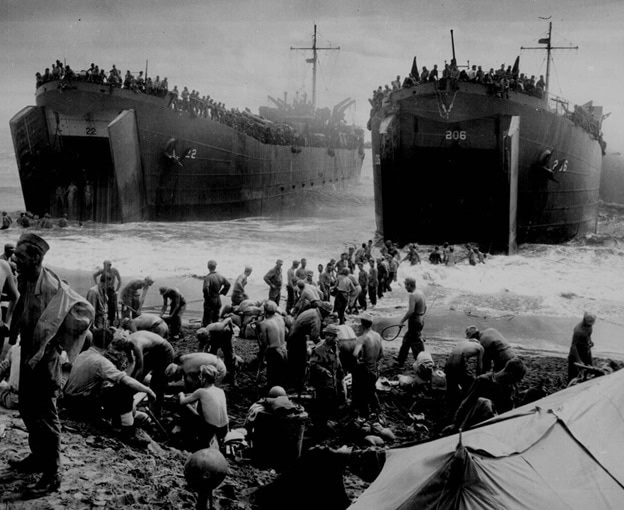
Mr. Berman had never been to sea, and an LST is slow (eight to ten miles per hour) because of the blunt clamshell doors that form the bow and would roll heavily in ocean waves because she was flat-bottomed. It was the only type of assault ship that was designed to be run up on a beach to disgorge troops, tanks and supplies. As it approached the beach, an LST would fill ballast tanks near the stern so that the bow angled higher, and then the crew would lower a Danforth anchor at the stern. The LST would intentionally run aground on the shore, unload the 147 marine infantry men and their 16 officers, reload the LST with casualties and then winch in the anchor rode to “kedge” the 328-foot ship off the beach.
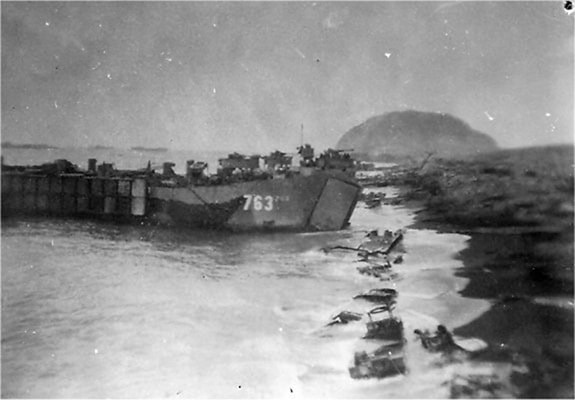
Mr. Berman’s LST 763 saw some bloody action, landing troops ashore on Iwo Jima and Okinawa, and earning two battle stars. Operational security meant that Mr. Berman could not write home about his location, but when newspapers and newsreels back home showed his LST at Iwo Jima, his family learned where he was. He was gently chided by his new wife for forgetting to send her a valentine.
During General Quarters, Mr. Berman was an ammunition loader of a twin Bofors 40 mm gun that flung two-pound explosive shells up to three nautical miles. The Bofors 40 mm twin and quad mount guns were the main anti-aircraft battery onboard U.S. Navy and Coast Guard ships during World War II.
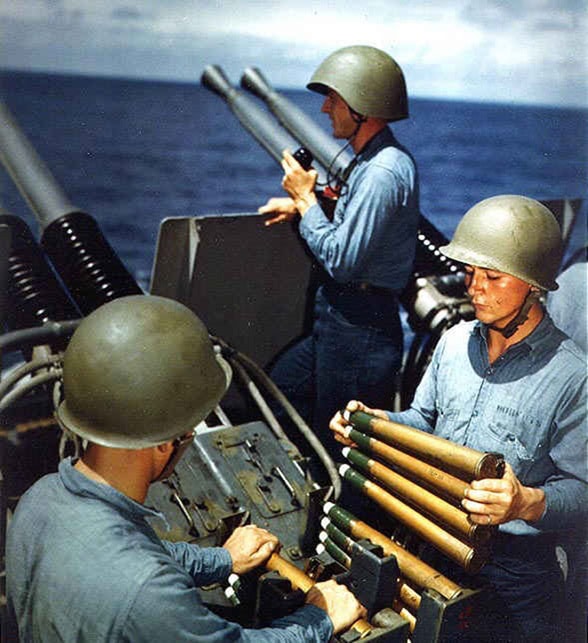
Firing at a rate of 140 rounds per minute, per barrel, teamwork among the two loaders was essential in keeping the guns fed. With this rate of fire, it didn’t take long for the barrels to heat to a cherry red color after burning off their haze gray paint. When I asked about the fear experienced by the LST’s crew during combat, Mr. Berman revealed that one loader froze up and began shaking violently. He was forcefully replaced and sent below in disgrace, but Mr. Berman sympathized with the sailor’s plight.
Running an amphibious assault ship onto to a defended beach is a scary endeavor. Enemy troops would begin firing artillery as soon as LSTs were within range and then launch mortar shells and fire machine guns as the landing craft approached the shore. While grounded, the LSTs were an even easier target, and Mr. Berman recalled that parts of LST 763’s superstructure were riddled with bullet holes and “looked like Swiss cheese” after the Iwo Jima invasion. LST 763 was pounded from the air, too, as Japanese planes strafed and bombed the shoreline. Because Navy “Hellcats” and “Corsairs” swooped in after the “Zeros” and “Bettys,” gun crews on LST 763 were told to fire only at shore targets, to prevent any “friendly fire” incidents. Mr. Berman was frustrated when a Zero passed by “so close we couldn’t have missed it,” but the crew followed their orders.
Mr. Berman was deeply affected by the sight of our flag being raised by the marines on Mt. Suribachi, signifying victory. He was overcome emotionally even now when he remembered it. But it was the sight and the smell of the wounded, the dying and the dead that deeply affected Mr. Berman. He choked up and cried when the thought of these Marine casualties returned after 80 years, and even now he bitterly raged against the Japanese adversary.
An even worse experience for Mr. Berman was the Okinawa invasion. The Japanese began wide scale use of kamikaze suicide planes that made a one-way trip into U.S. Navy warships, causing severe damage to them or sinking them outright. He witnessed the explosion on board a nearby aircraft carrier, probably USS Hancock, which was struck by a kamikaze near Okinawa.
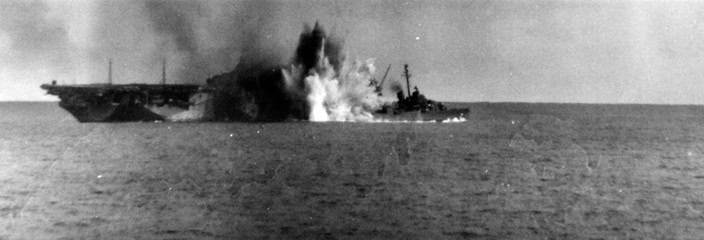
The Hancock was not alone. At Okinawa, the Japanese launched 1,500 attacks that damaged or sank 149 ships, and killing 3,048 and injuring another 6,035 sailors. The battles raged into the night, and Mr. Berman remembers explosions so fierce that some nights were as bright as day. An LST next to Mr. Berman’s LST 763 was struck by a kamikaze and severely damaged, with some of her crew rescued by their sister ship. The butcher’s bill was so high at Okinawa that all of hospital ships in the invasion fleet were soon overloaded with Marine, Army, Coast Guard and Navy wounded. LSTs like Mr. Berman’s became auxiliary hospital ships by necessity, and Mr. Berman still remembers the all-night shrieks and wailing of the wounded that were brought onboard with rage and tears as he told his story. After the war, he suffered from what is now called Post Traumatic Stress Disorder due to his experiences.
After Japan surrendered, LST 763 sailed to Japan as part of the occupation force. Mr. Berman was one of the few crew members allowed to go ashore. Despite the surrender, U.S. warships entered Japanese waters on high alert and Mr. Berman, and the rest of the shore party carried sidearms. They found devastation, fear and hatred, and were told that any food that would be offered to them might be poisoned.
U.S. servicemen were chosen to return home from the war in a sequence determined by a point system that included factors like time in service and time in combat. Even so, Mr. Berman’s ship did not sail into San Francisco Bay until 1946. When someone today says, “Thank you for your service”, Mr. Berman replies that it was his solemn duty to defend our country. He modestly states that he wasn’t unique; there were a million more just like him, who put service to their country first.
Note: This article was previously published as part of the United States Coast Guard’s The Long Blue Line Series.